Subtotal $0.00

When most people begin a fitness program, they are thinking about the workout itself.
How much weight should I lift? How much cardio do I need? How many calories can I burn? How quickly can I get stronger?
Those are all reasonable questions. But before deciding how much work we should ask the body to perform, there is another question worth considering:
How well does your body move right now?
Every person brings something different into the gym. Your exercise history, occupation, daily habits, previous activities, mobility, strength, coordination, and even the amount of time you spend sitting or standing can influence how you move.
That is where corrective exercise can become useful.
Corrective exercise uses information gathered from a client’s history and movement assessments to identify areas that may benefit from additional mobility, strength, stability, control, or movement practice. ISSA similarly describes corrective exercise as an individualized process built around a client’s movement patterns, restrictions, lifestyle, assessments, and goals.
The objective isn’t to convince someone that something is “wrong” with their body.
The objective is much simpler:
Move better so you can train better.
What Is Corrective Exercise?
Corrective exercise is not one particular stretch, resistance-band exercise, or warm-up routine.
It is an approach to exercise programming.
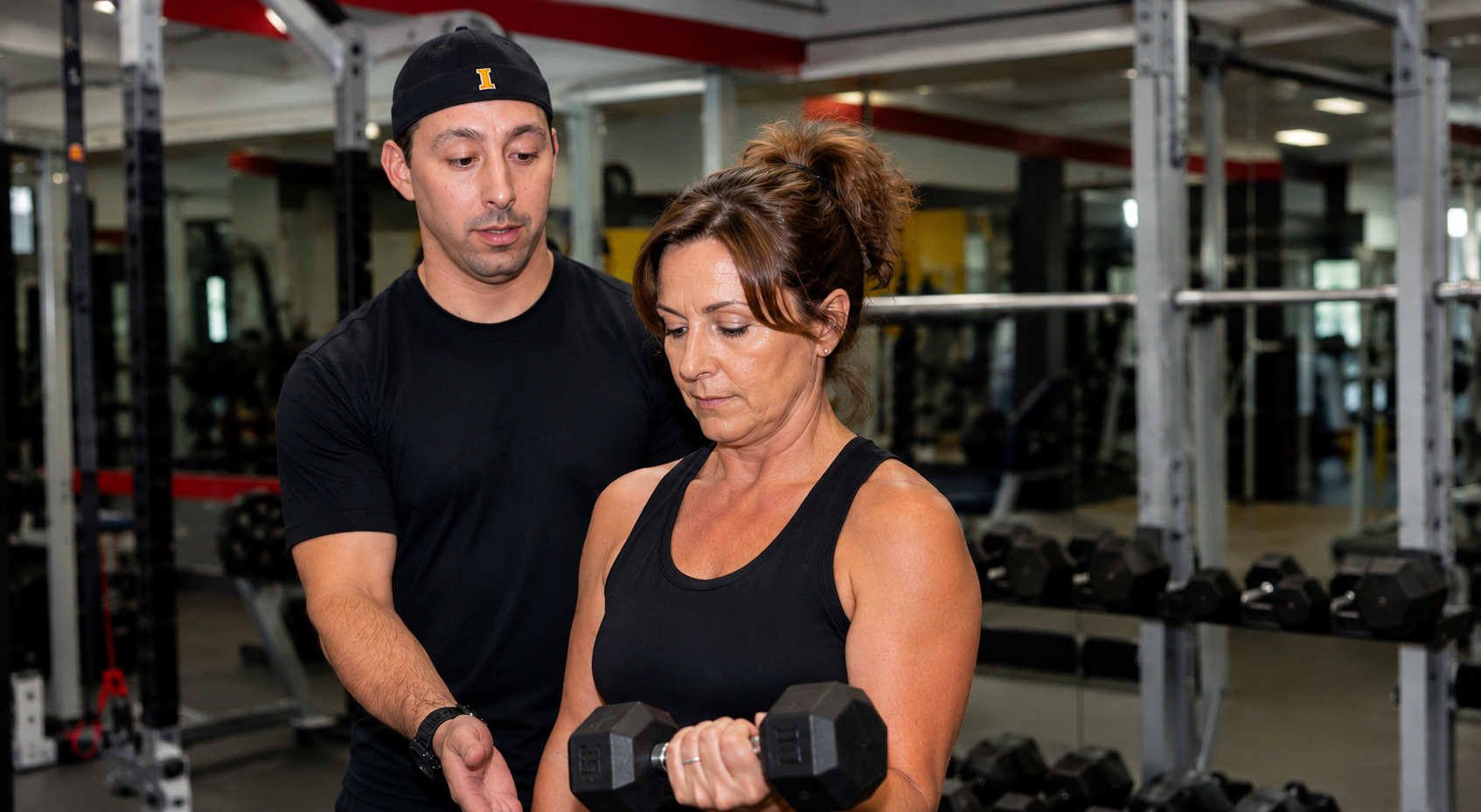
A trainer first gathers information about how a client currently moves. From there, specific exercises can be selected to address areas that may be limiting the client’s ability to move efficiently or perform an exercise well.
Depending on the individual, corrective work might include:
- Mobility exercises
- Flexibility work
- Targeted strengthening
- Muscle activation exercises
- Balance or stability exercises
- Movement-pattern practice
- Integrated exercises involving several joints and muscle groups
The important word is individual.
Two people may demonstrate what looks like the same movement compensation but arrive there for different reasons. That is one reason corrective programming should be based on the person in front of the trainer rather than automatically prescribing the same exercise whenever a particular movement is observed.
ISSA makes this same point in its corrective-exercise guidance: no two clients should automatically receive the same corrective program because their movement restrictions, imbalances, histories, and goals differ.
The Assessment Starts Before You Exercise
A good movement assessment begins before the first squat, push-up, or resistance exercise.
I want to know something about the person performing the movement.
What do you do for work?
Do you spend most of your day sitting?
Are you on your feet for several hours?
Does your job require you to repeat the same motions over and over?
What sports or recreational activities do you participate in?
What is your previous exercise experience?
What are you trying to accomplish now?
Those questions provide context.
ISSA recommends considering factors such as occupation, time spent sitting or standing, repetitive daily movements, footwear, hobbies, and overall activity level before developing corrective programming.
That information matters because an assessment shouldn’t be treated like a machine that produces an automatic answer:
See this movement → prescribe this exercise.
Instead, the assessment is one part of a larger conversation about the client.
What Can a Movement Assessment Tell Us?
One of the tools I use when evaluating a new client is an Overhead Squat Assessment.
The squat asks several parts of the body to work together at the same time. While the client performs the movement with the arms overhead, I can observe what is happening at the ankles, knees, hips, torso, and shoulders.
I might notice things such as:
- The heels rising
- The knees moving inward or outward
- Excessive forward movement of the torso
- Changes in hip position
- Difficulty maintaining the arms overhead
Researchers have also used overhead-squat testing to examine movement at the shoulder, trunk, hip, knee, and ankle, which illustrates why the movement can provide useful information about whole-body coordination.
But this distinction is extremely important:
An exercise assessment is not a medical diagnosis.
If someone’s knees move inward during a squat, that does not automatically tell us that one particular muscle is damaged, that the person is injured, or that an injury is going to occur.
Movement is influenced by many things—mobility, strength, coordination, anatomy, experience, fatigue, previous activity and other individual factors.
The assessment gives us information that can help guide training.
It does not give us a crystal ball.
What Can Corrective Exercise Include?
Once we have identified something we would like to improve, there are several ways we might address it.
Mobility and Flexibility
Sometimes a client may have difficulty accessing the range of motion needed for a movement.
In that situation, mobility work or appropriate stretching may be useful as part of the warm-up or training program.
For example, ankle mobility can influence mechanics during squatting. Research has found relationships between available ankle dorsiflexion and lower-extremity movement during squat tasks.
That does not mean every squat problem comes from the ankle. It means mobility is one factor we can examine.
Targeted Strengthening and Activation
Other situations may benefit from improving strength or control.
These exercises are often relatively simple and deliberate. The purpose may be to help the client become better at producing or controlling a particular movement before asking them to perform it under greater resistance or complexity.
A resistance-band exercise, for example, could be used during a warm-up to practice upper-back or shoulder control before progressing into the primary workout.
Movement Practice
Eventually, the body has to put the pieces back together.
That means practicing complete movements such as squatting, pushing, pulling, hinging, stepping, carrying, or other exercises appropriate to the client’s program.
Corrective work shouldn’t exist in isolation from training.
If we improve mobility or strengthen an area but never teach the body how to use that improvement during real movement, we have missed part of the point.
Progressive Training
Corrective exercise should ultimately support the larger training program.
The client still needs progressive exercise to become stronger, build muscle, improve cardiovascular fitness, increase work capacity, improve athletic performance, or accomplish whatever brought them into the gym in the first place.
Corrective exercise is a tool within the program—not the entire program.
Why Corrective Exercise Fits Well in the Warm-Up
One of the most practical places for corrective work is before the primary workout.
A warm-up should do more than simply make you sweat.
It should help prepare you for the training you are about to perform.
That can begin with general movement or cardiovascular activity and then transition into mobility, activation, or movement-preparation exercises selected for the individual.
From there, we move into the main workout.
The process becomes:
Prepare → Address individual needs → Train
That allows us to work consistently on movement without allowing corrective exercises to consume the entire training session.
Over time, those few minutes of focused preparation can add up to a significant amount of practice.
Corrective Exercise Should Be Individualized
Consider two clients who both have the same goal:
Lose weight and become stronger.
Their primary training programs may eventually contain many of the same fundamental movements—squats, pushes, pulls, hinges, carries, and cardiovascular exercise.
But their preparation may look completely different.
One may need more attention to lower-body mobility and control.
Another may move well through the lower body but need additional work involving shoulder mobility or upper-body positioning.
Another client might require very little corrective work at all.
The goal isn’t to find as many “problems” as possible.
The goal is to identify what actually deserves attention and then use that information to make the training more appropriate for the person.
That individuality is also emphasized in ISSA’s corrective-exercise guidance, which recommends building programs around the client’s particular restrictions and assessment findings rather than generalizing from other clients.
Corrective Exercise Does Not Mean You Have to Move Perfectly Before You Train
This is another important misconception.
You do not have to demonstrate perfect movement before you are allowed to lift weights, exercise, or improve your fitness.
In fact, regular resistance training can itself help develop strength, coordination, control, and physical capacity.
Corrective exercise and strength training do not need to compete with one another.
They should complement each other.
If we find something that can reasonably be improved, we address it.
Then we continue training.
As your strength and movement improve, the program progresses with you.
The objective isn’t perfection.
It is progress.
Corrective Exercise Is Not Physical Therapy
There is also an important professional boundary between personal training and healthcare.
A personal trainer can observe movement, teach exercise technique, adjust exercises, prescribe fitness programming within their professional scope, and refer a client when something appears to require medical evaluation.
A trainer does not diagnose injuries or medical conditions.
ISSA specifically emphasizes scope of practice and recommends referral to an appropriate medical professional when a client’s situation falls outside the trainer’s role.
Pain deserves particular attention.
If someone experiences unexplained or significant pain, numbness, tingling, symptoms inside a joint, or other concerning symptoms, the answer is not simply to keep adding corrective exercises.
Sometimes the correct coaching decision is:
Stop and refer.
That is part of advocating for the client too.
What About Injury Prevention?
You will sometimes hear corrective exercise described as a way to “prevent injury.”
I prefer to be more careful with that claim.
Improving mobility, strength, control, and movement quality can all be worthwhile training objectives. Corrective interventions have also been shown to improve scores on functional-movement assessments in some populations.
But improving a movement-screen score is not the same thing as knowing whether someone will or will not become injured.
Systematic reviews of movement-screening tools have found limitations in their ability to predict future injury accurately across individuals and populations.
So I don’t view an assessment as a prediction of what will happen to you.
I view it as information about how you move today and an opportunity to make more informed programming decisions.
Corrective Exercises Should Change When You Change
Corrective exercises shouldn’t automatically become permanent.
There should be a reason an exercise is in your program.
And if there is a reason for putting it in, there should eventually be a reason for taking it out, modifying it, or progressing it.
That is why reassessment matters.
We can follow a simple process:
Assess → Program → Train → Reassess
If ankle mobility improves, we should recognize that.
If squat control improves, we should recognize that.
If shoulder positioning changes, the program may change with it.
A client shouldn’t still be doing the exact same corrective routine six months later simply because those were the exercises selected on Day One.
Training should evolve as the person evolves.
Corrective Exercise Supports the Goal—It Isn’t the Goal
Very few people join a gym because their ultimate goal is to become excellent at corrective exercise.
They come because they want something larger.
They want to lose weight.
Become stronger.
Build muscle.
Improve their health.
Feel better performing everyday activities.
Improve athletic performance.
Increase confidence.
Corrective exercise can support those goals, but it should not replace them.
The assessment helps us understand where you are starting.
Corrective work gives us tools for addressing areas that deserve attention.
Progressive training builds the strength, fitness, and capacity needed to move toward your goal.
Reassessment tells us whether we need to change course.
Move Better. Train Better.
A well-designed training program is more than a list of exercises.
It should consider the person performing them.
Your goals matter.
Your exercise history matters.
Your daily activity matters.
Your movement matters.
And your progress matters.
That process can begin during your initial consultation, where we discuss your goals, exercise history, motivation, nutrition, and training needs while evaluating where you are starting.
Movement assessment and corrective exercise may become part of that solution.
Not because you need to move perfectly before you are allowed to train.
Not because every movement difference means something is wrong.
And not because an assessment can predict your future.
We use them because better information allows us to make better coaching decisions.
And when we identify something that can help you move better, we can use that information to help you train with greater purpose.
Every Client Deserves an Advocate.

Comments are closed