Subtotal $0.00

When people think about getting stronger, they usually focus on the larger muscle groups.
They think about building a stronger chest, back, legs, shoulders, or arms.
But almost every weight you lift with your upper body has to pass through one much smaller connection point first:
Your hands.
Whether you are holding a dumbbell, pulling a barbell from the floor, carrying groceries, using a kettlebell, or hanging from a pull-up bar, your ability to control that resistance depends largely on the strength of your hands, wrists, and forearms.
That makes grip strength an important part of training that is easy to overlook.
A strong grip is not just about having a firm handshake or being able to squeeze something hard. It affects your ability to hold, carry, pull, and control resistance—and in some exercises, your grip may become the limiting factor before the larger muscles you are trying to train are actually finished working.
That is why grip, wrist, and forearm strength deserve attention as part of a complete strength-training program.
Grip Strength Is Part of Everyday Strength
Grip strength is something most people use throughout the day without giving it much thought.
Carrying grocery bags, opening a jar, picking up a suitcase, holding tools, moving furniture, carrying a child, or even holding onto a railing all require the hands and forearms to produce and control force.
In many of those situations, grip strength is not working by itself. Your hands are the connection between your body and whatever you are trying to move, carry, or control.
You may have the leg strength to carry something heavy across a room, for example, but that strength is not very useful if your hands cannot maintain a secure hold on the object.
The same thing can happen as we get older. Maintaining strength is not only about how much weight someone can lift in the gym. It is also about maintaining the physical ability to perform everyday tasks independently and confidently.
That is one reason grip strength is frequently used in research as a simple measure of overall physical function. A stronger grip does not automatically mean someone is healthier in every way, but it can provide useful information about a person’s broader strength and physical capability.
A systematic review of 83 studies found that handgrip strength was associated with mobility, balance, and independence in activities of daily living among older adults.
The important point is that grip strength has value long before we ever talk about deadlifts, pull-ups, or forearm exercises. It is part of being physically capable in everyday life.
Why Don’t We Use Our Grip Like Previous Generations Did?
For many people, previous generations had something built into their everyday lives that we now have to intentionally recreate:
Regular physical work.
Think about the kinds of jobs that were more common for our grandparents and great-grandparents. Farming, mining, construction, manufacturing, mechanical work, and other forms of manual labor required people to lift, carry, pull, turn, hold, and manipulate objects throughout the day.
Their grip was being challenged constantly.
They weren’t necessarily doing dedicated forearm workouts or grip-training programs. Their hands, wrists, and forearms became stronger because daily life repeatedly required them to produce force.
For many of us, modern life looks very different.
A large percentage of work now involves computers, phones, machinery, or other tasks where the hands may still be used constantly—but they are not necessarily being asked to produce much strength.
Typing is a good example.
Your fingers may perform thousands of movements throughout the day, but each movement requires very little force. The hands are busy, but they are not receiving the same kind of strength stimulus they would get from carrying tools, moving materials, handling heavy objects, or performing other forms of manual work.
The same idea applies outside of work.
Power steering replaced much of the effort once required to turn a steering wheel. Power tools replaced many hand tools. Wheeled luggage replaced carrying heavy bags. Grocery carts, delivery services, automated equipment, and countless other conveniences have made everyday life easier.
Those conveniences are useful—but they also mean we have fewer opportunities to challenge our grip naturally.
So our hands haven’t necessarily become less active.
They have become active in ways that often require much less strength.
Research looking at grip strength measurements across decades in Canada and the United States found a decline in adult grip strength over time, although the reasons for that trend are likely complex rather than attributable to one lifestyle change alone.
That is one reason deliberate grip, wrist, and forearm training can be valuable today. The gym gives us a way to recreate some of the physical demands that everyday life may no longer provide.
How the Gym Helps Build That Everyday Capacity
If everyday life no longer challenges the hands, wrists, and forearms the way it once did, the gym gives us a place to deliberately train those qualities.
The key is resistance.
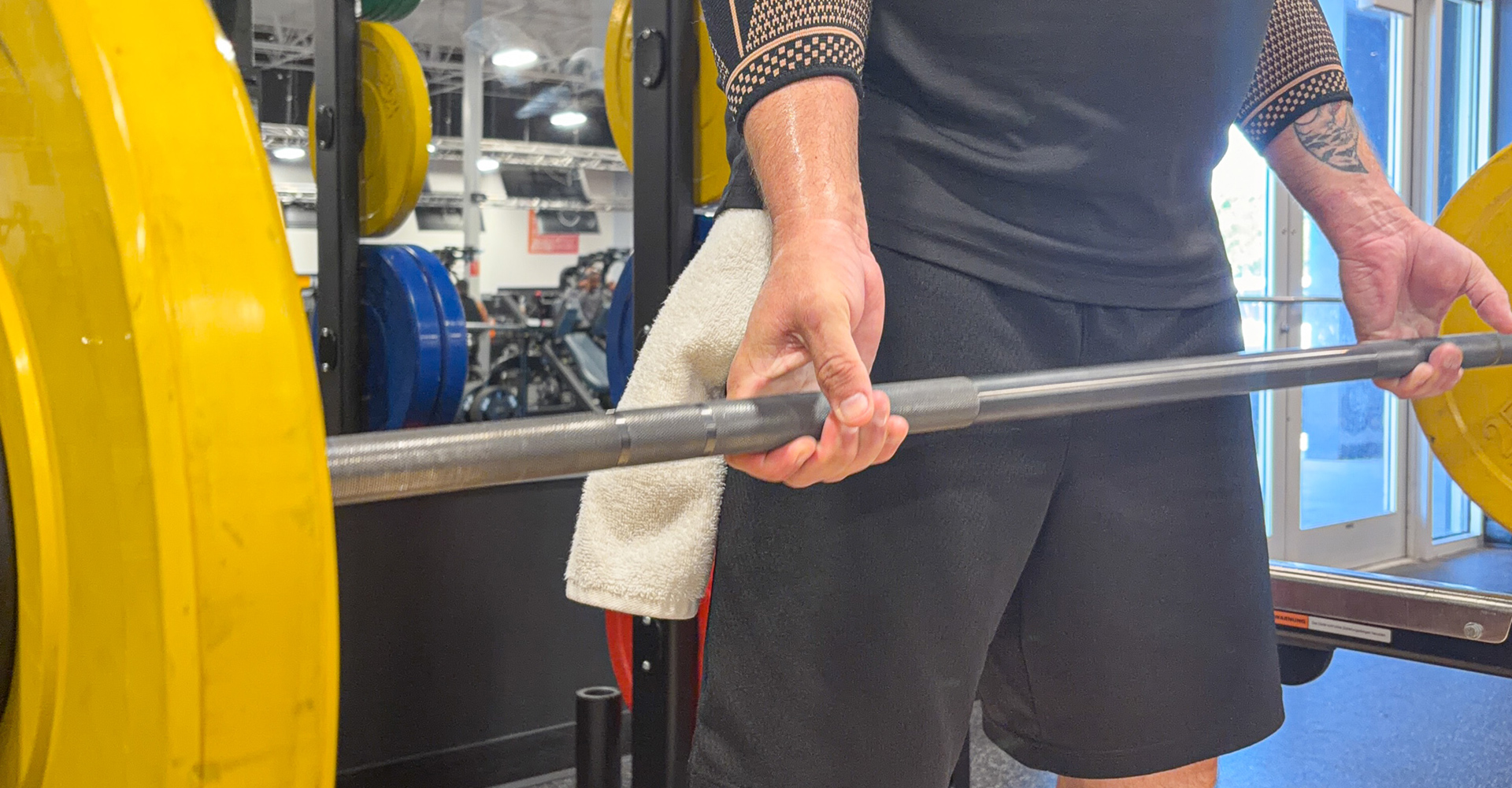
When you carry a pair of dumbbells, hold onto a loaded barbell, hang from a pull-up bar, or perform a rowing movement, your hands and forearms have to produce and maintain enough force to keep control of the load.
That is very different from simply using the hands throughout the day.
The gym allows us to progressively increase those demands over time. Just like we can make the legs stronger by gradually increasing the resistance in a squat or leg press, we can also make the grip and forearms stronger by asking them to hold, carry, squeeze, and control progressively greater resistance.
A simple example is the farmer carry.
You pick up a weight in each hand and walk while maintaining control of the load. Your hands and forearms have to maintain the grip, while your shoulders, trunk, hips, and legs work together to move your body.
Outside the gym, that same basic ability shows up when you carry grocery bags, luggage, tools, or other heavy objects.
The gym lets us take something we need in everyday life and train it in a controlled, measurable way.
That is the real value of grip training: not just stronger hands, but a greater ability to use your strength when you need it.
Farmer Carry — Support Grip
Different Types of Grip Strength
Grip strength is not just one thing.
Depending on the task, your hands may need to hold onto something for time, squeeze something forcefully, or control an object between the fingers and thumb.
That means different exercises can challenge the grip in different ways.
Support Grip
Support grip is your ability to hold onto an object and maintain that hold over time.
This is the type of grip used during exercises such as:
- Farmer carries
- Deadlifts
- Romanian deadlifts
- Dead hangs
- Rows
- Pull-ups
- Many dumbbell exercises
It is also one of the most transferable forms of grip strength to everyday life. Carrying grocery bags, luggage, tools, or other heavy objects often depends on your ability to maintain a secure hold long enough to finish the task.
The farmer carry we just discussed is a perfect example of support grip because the challenge is not simply picking the weight up. You have to continue holding it while the rest of your body is working.
Crushing Grip
Crushing grip involves closing the fingers toward the palm and squeezing an object.
Hand grippers are probably the most recognizable example.
This type of grip is useful whenever you need to create force through the hand itself, but it is only one part of overall grip strength.
Someone can be very good at squeezing a hand gripper and still struggle to hold a heavy barbell for an extended period because those tasks place different demands on the hand and forearm.
Pinch Grip
Pinch grip places more emphasis on the relationship between the fingers and thumb.
A common gym example is holding weight plates together with the fingers on one side and the thumb on the other.
Outside the gym, this type of strength comes into play whenever you are gripping or controlling an object that does not give you a full handle to wrap your hand around.
The important takeaway is that a “strong grip” does not always mean the same thing.
Holding, squeezing, and pinching are different demands, and a well-rounded approach to grip training can challenge more than one of them.
Grip Strength Is Only Part of the Story: The Wrist and Forearms
Grip strength gets most of the attention, but your ability to hold onto something is only part of what the hands and forearms are doing.
The muscles of the forearm also help control the position and movement of the wrist.
That matters because the wrist acts as the connection between the hand and the rest of the arm.
If the wrist cannot maintain a strong, stable position, it can become harder to transfer force efficiently through the hand.
Think about a dumbbell curl.
The goal may be to train the biceps, but if the wrist keeps bending backward under the load, some of your effort is being lost at the point where the hand connects to the weight.
The same idea applies to presses, carries, rows, curls, and many other exercises.
A stronger wrist and forearm can help you:
- Maintain better control of the load
- Keep the wrist in a stronger position
- Handle heavier resistance more confidently
- Reduce the chance that the grip gives out before the larger muscles being trained
- Improve the connection between the hand and the rest of the movement
The forearms also contribute to several different actions at the wrist and forearm, including:
Wrist flexion — bending the palm toward the forearm
Wrist extension — bringing the back of the hand toward the forearm
Pronation — rotating the forearm so the palm turns downward
Supination — rotating the forearm so the palm turns upward
These movements show why forearm training is more than simply squeezing harder.
A well-rounded approach can include exercises that challenge the hand to hold, the wrist to stay stable, and the forearm to move and control the wrist through different positions.
Barbell Wrist Curl — Direct Forearm Training
A barbell wrist curl is a more direct way to strengthen the muscles involved in wrist flexion.
With the forearms supported, the movement comes primarily from the wrist rather than the entire arm.
That makes it very different from a farmer carry.
The farmer carry challenges your ability to maintain a grip while the entire body is working.
The barbell wrist curl focuses more directly on strengthening the muscles that move and control the wrist.
Both exercises involve the forearms, but they train them in different ways.
That is an important distinction because a complete approach to grip and forearm strength should not rely on only one type of exercise.
Why Grip Strength Can Become the Limiting Factor in the Gym
One of the easiest ways to understand the importance of grip strength is to notice what happens when it becomes the first thing to fail.
Imagine performing a set of Romanian deadlifts.
Your hamstrings and glutes may still be capable of producing more force, but if the bar starts slipping from your hands, the set is probably over.
The same thing can happen during:
- Rows
- Pulldowns
- Pull-ups
- Deadlifts
- Shrugs
- Heavy dumbbell work
- Farmer carries
In those situations, the larger muscles may still have more to give, but the hands and forearms can become the weak link in the chain.
That does not mean grip should always be removed from the equation.
Sometimes grip fatigue is exactly what we want.
If the goal of an exercise is to improve grip strength, then allowing the hands and forearms to be challenged makes sense.
But if the goal is to heavily train the back, hamstrings, or another larger muscle group, and grip consistently gives out first, then grip may be limiting the effectiveness of the exercise.
This is where training has to match the goal.
For some exercises, I may want the grip to work as hard as possible.
For others, I may use a tool such as lifting straps so the target muscles can continue working even after the grip starts to fatigue.
A 2026 review of lifting-strap research found evidence that straps can improve maximal strength and perceived grip security and may increase mechanical work during deadlifts, while the effects across pulling and back exercises are less consistent.
The important point is not that straps are good or bad.
The important point is:
What are we trying to train?
If grip strength is the goal, train the grip.
If the grip is preventing another muscle group from getting the training it needs, then it may make sense to reduce that limitation.
That is another reason grip training deserves its own attention. The stronger your grip becomes, the less likely it is to interfere with the rest of your strength training.
How to Train Grip, Wrist, and Forearm Strength
The good news is that you usually do not need an entire workout devoted to your hands and forearms.
Many strength exercises already challenge the grip indirectly. Rows, deadlifts, pull-ups, dumbbell exercises, and carries all require the hands and forearms to work.
From there, we can add a small amount of direct training based on what we actually want to improve.
Farmer Carries
Farmer carries are one of the simplest ways to challenge support grip.
Pick up a weight in each hand, maintain good posture, and walk under control.
As your grip improves, you can gradually increase the load, the distance, or the amount of time you carry the weight.
The important part is maintaining control rather than simply seeing how long you can hold on after your posture begins to break down.
Dead Hangs
Hanging from a pull-up bar challenges your ability to support your bodyweight through your hands.
This can be a useful way to build grip endurance, although the exercise also requires adequate shoulder comfort and control.
Like any exercise, it should fit the individual rather than being automatically prescribed to everyone.
Plate Pinches
Plate pinches challenge the pinch grip.
Instead of wrapping the entire hand around a handle, the fingers and thumb have to maintain pressure against the sides of the plates.
That gives the hands a different challenge than a barbell, dumbbell, or farmer carry.
Hand Grippers
Hand grippers are a simple way to directly train crushing grip.
They can be useful, but they represent only one type of grip strength.
Someone who only trains with grippers may become very good at squeezing while still having room to improve support grip, pinch grip, or wrist strength.
Wrist Curls and Wrist Extensions
Direct wrist exercises allow us to strengthen the muscles that move the wrist through flexion and extension.
The barbell wrist curl shown earlier is one example.
Wrist extensions train the opposite side of the movement and can help provide more balanced direct forearm training rather than only focusing on the muscles that flex the wrist.
Forearm Rotation
The forearms are also responsible for rotating the hand between palm-up and palm-down positions.
Controlled pronation and supination exercises can be performed using light resistance and a controlled range of motion.
Because the resistance is farther from the wrist in some of these exercises, it often does not take much weight to create a meaningful challenge.
Progress Grip Strength Like Any Other Form of Strength
Grip training follows the same basic principle as the rest of strength training:
The body needs a reason to adapt.
If you always carry the same weight for the same distance, squeeze the same gripper for the same number of repetitions, or perform wrist curls with the same resistance indefinitely, eventually the challenge may no longer be enough to continue producing progress.
That does not mean adding weight every single workout.
Progress can come from:
- Increasing resistance
- Holding a weight longer
- Carrying it farther
- Performing additional controlled repetitions
- Using a more challenging grip
- Improving control through a larger range of motion
At the same time, the hands and forearms already participate in a lot of other training.
More grip work is not automatically better.
The goal is to provide enough additional challenge to improve, while still allowing the hands, wrists, and forearms to recover for the rest of your training and everyday activities.
Why Grip Strength Matters More as We Age
Grip strength becomes even more important when we stop thinking only about gym performance and start thinking about maintaining independence.
As people get older, strength affects the ability to keep doing everyday tasks without assistance.
That includes things like:
- Carrying groceries
- Opening containers
- Using tools
- Lifting household objects
- Carrying bags
- Holding onto railings
- Moving items around the house
- Performing other activities that require the hands to maintain control
Grip strength is especially useful to researchers because it is relatively easy to measure with a handgrip dynamometer.
Because of that, it has become one of the most commonly studied measures of strength in older adults.
A systematic review of 83 studies found handgrip strength was associated with mobility, balance, and independence in activities of daily living.
That does not mean grip strength alone determines whether someone will remain independent.
It is better to think of it as one useful window into a person’s broader physical capability.
Someone who maintains muscular strength throughout the body is generally better equipped to handle the physical demands of everyday life than someone who has allowed that strength to decline.
Grip happens to be one of the easiest places to measure that difference.
Grip strength has also been studied extensively in relation to long-term health outcomes. One systematic review examining grip-strength measurement in mortality research included more than 3 million participants.
That research helps illustrate how widely grip strength is used as a marker of physical function and health, but it also highlights an important limitation: grip-strength testing methods vary considerably between studies.
Again, the important point is not that simply developing a stronger grip guarantees better health or a longer life.
Grip strength can reflect a much bigger picture that includes overall muscular strength, physical activity, health status, nutrition, age, and physical function.
So I would not tell someone:
“Train your grip because it will make you live longer.”
I would tell them:
“Maintaining your strength—including your grip—is part of maintaining your physical capability as you age.”
That is a much more useful reason to train it.
Grip Fatigue Is Not the Same as Pain
When you train your grip, wrists, and forearms, some fatigue is expected.
Your forearms may burn during a farmer carry. Your hands may feel tired after a heavy pulling session. Your grip may simply stop producing the same amount of force near the end of a set.
That is part of training.
Pain is different.
Persistent wrist pain, hand pain, elbow pain, numbness, tingling, or symptoms that continue outside of training should not automatically be treated as something you just need to “strengthen through.”
The hands and forearms are used constantly in everyday life, so excessive training volume can also become a problem if direct grip work is piled on top of a large amount of pulling, carrying, curling, and other exercises.
That is another reason grip training should be programmed with purpose.
You want enough work to create an adaptation, but not so much that your grip, wrists, or forearms are constantly fatigued and interfere with the rest of your training.
If discomfort appears, the first step may simply be adjusting the exercise, resistance, volume, or technique.
But symptoms such as persistent pain, numbness, tingling, loss of sensation, or unexplained weakness may require evaluation by an appropriate healthcare professional.
A personal trainer can help build strength and improve exercise technique.
A trainer should not try to diagnose conditions such as carpal tunnel syndrome, tendon injuries, or nerve problems.
The goal of grip training is to build capacity—not to see how much discomfort you can tolerate.
Stronger From the Hands Up
Grip strength may seem like a small piece of the bigger fitness picture, but it affects far more than just how hard you can squeeze.
Your hands, wrists, and forearms help you hold, carry, pull, control, and stabilize resistance in the gym—and they help you perform countless tasks outside of it.
For previous generations, much of that strength was built into daily life through manual work and regular physical demands.
For many of us today, that is no longer the case.
Our hands may still be busy, but they are often busy in ways that require very little force.
That means grip strength, wrist strength, and forearm strength may need to be trained more intentionally.
The gym gives us a controlled way to do that.
Farmer carries can build support grip.
Plate pinches can challenge pinch grip.
Hand grippers can train crushing strength.
Wrist curls and extensions can directly strengthen the muscles that control the wrist.
And heavy pulling and carrying movements can teach the hands and forearms to maintain force while the rest of the body is working.
The goal is not to turn every workout into a forearm workout.
The goal is to make sure your grip is strong enough to support everything else you are trying to do.
Because sometimes the difference between being able to use your strength and not being able to use it comes down to one simple question:
Can you hold on?
At Mendez Personal Training, I build training around the individual—their goals, current abilities, training history, and the areas that can help them make progress.
Grip, wrist, and forearm training may only be one small part of that plan.
But when it helps someone become stronger, more capable, and more confident in everyday life, it deserves attention.
Every Client Deserves an Advocate.

Comments are closed